Breaking Up With
My Default Stack
Torres del Paine, Patagonia
Backstage
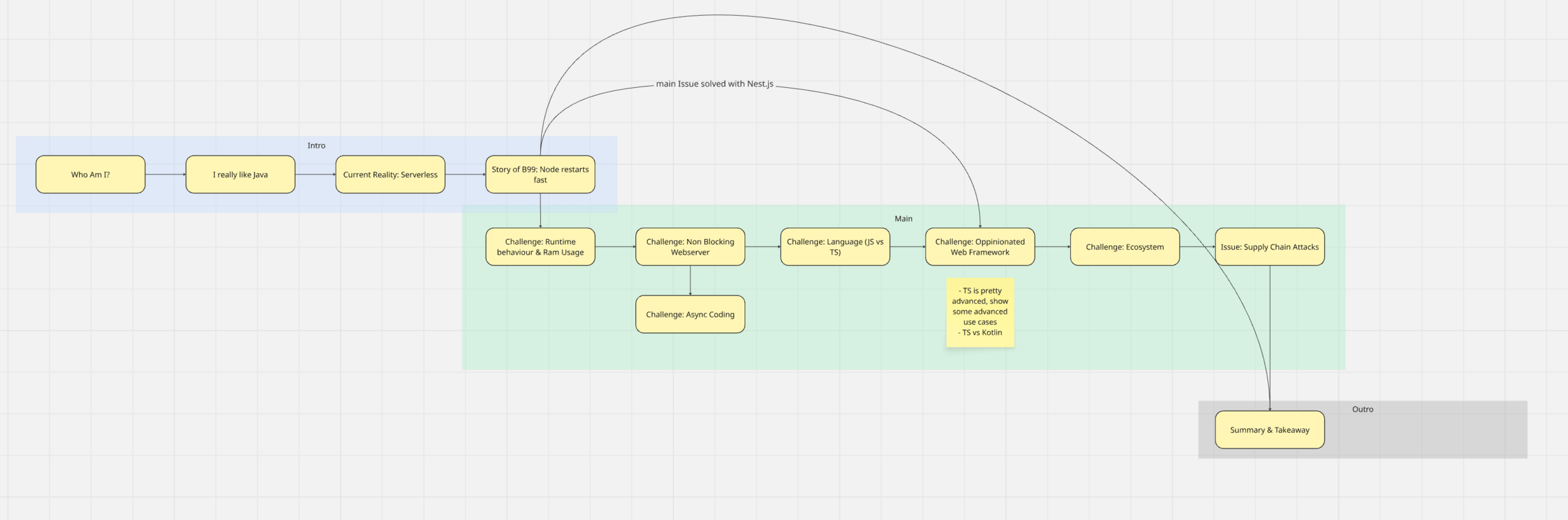
Storytelling Techniques
Storytelling Techniques
Storytelling Techniques
- Where are you?
- Simple. Make the listener imagine what it looks like
- Actions: What are you doing in that specific point moment
- Walking, Biking, etc. It brings forward moment, it brings listener to the moment. Listeners they know you are not wasting their time
- What are your thoughts?
- "I thought, that would be so cool"; Raw unfiltered, juiicy
- What are you feeling?
- Show emotion with body posture

Purpose
Why am I telling this story?
What do I want people to know / have learnt?
Patrick Favre



 github.com/patrickfav
i love the java ecosystem
... then I was put on a node project...
..., and now my reality is serverless
Challenges
- Startup of JVM is super slow
- JVM uses lots of RAM, especially threaded webserver under load
Reality
- Customer is incredibly ops cost sensitive
- Focus on on demand resources like Lambdas

Node startup times
Node RAM usage
Blocking I/O. Each connection consumes significant memory and waits for database/disk responses.
Non-blocking. Offloads I/O tasks and continues processing other requests in the event loop.
Non Blocking vs. Threaded
- → No complex thread management
- → Readable business logic
However, requires understanding of micro and macro task queue which might run into starvation bugs if used incorrectly.
- → Controllers, Services, Repos... all reactive
- → Complex operator nesting (flatMap, zip)
- → Harder to debug and stack trace
Async/Await vs. Java Reactive Models
vs.
Syntactic Sugar vs. Flowable Complexity
async function saveOrder(order: Order) {
  const user = await db.users.find(order.uid);
  const result = await db.orders.insert(order);
  await email.send(user.email, "Success!");
  return result;
}

// Mock DB
const db = {
  users: {
    find: async (id: string): Promise<User | null> => {
      return { id, email: "user@example.com" };
    },
  },
  ...
};

//Service
const emailService = {
  send: async (email: string, message: string):
  Promise<void> => {
    console.log(`Email sent to ${email}: ${message}`);
  },
};
public Mono<Order> saveOrder(Order order) {
return userRepository.findById(order.getUid())
.flatMap(user -> orderRepository.save(order)
.flatMap(result -> emailService.send(user.getEmail())
.thenReturn(result)));
}
// Repository
public interface UserRepository {
Mono<User> findById(String id);
}
public interface OrderRepository {
Mono<Order> save(Order order);
}
// Service
public class EmailService {
public Mono<Void> send(String email, String message) {
return Mono.fromRunnable(() ->
System.out.println("Email sent to " + email)
);
}
}For reference: Coroutines
suspend fun saveOrderParallel(order: Order): Order = coroutineScope {
    val userDeferred = async { userRepository.findById(order.uid) }
    val saveDeferred = async { orderRepository.save(order) }

    val user = userDeferred.await()
        ?: throw IllegalStateException("User not found")

    val savedOrder = saveDeferred.await()

    emailService.send(user.email, "Order success!")

    savedOrder
}Typescript: From the Java Developers Perspective
{
  "strict": true,
  "noImplicitAny": true,
  "exactOptionalPropertyTypes": true
}Typescript allows for sophisticated infered types
TS has no type information during runtime, therefore schema validators, like Zod are often used.
TS allows to infer other, related, types from e.g. a schema.
import { z } from "zod";

export const CustomerSchema = z.object({
  id: z.string().uuid(),
  firstName: z.string().min(1),
  email: z.string().email().optional(),
  loyaltyPoints: z.number().int().nonnegative(),
});

/**
 * Infer TypeScript type from schema
 */
export type Customer = z.infer<typeof CustomerSchema>;

/*
 type Customer = {
    id: string;
    firstName: string;
    email?: string | undefined;
    loyaltyPoints: number;
 }
*/Typescript has expressive type-level language
The 20+ built-in utility types help to minimize type duplication by creating adapted infered types.
// 1. infer return type with ReturnType<>
function createCustomer() {
  return {
    name: "Alice",
    age: 30,
  };
}

type Customer = ReturnType<typeof createCustomer>; // { name: string; age: number;}

// 2. Extracts parameter types of a function as a tuple
function updateCustomer(id: string, age: number) {
  return true;
}

type UpdateParams = Parameters<typeof updateCustomer>; // [id: string, age: number]

//3. Remove properties from a type
type User = {
  id: string;
  email: string;
  password: string;
};

type PublicCustomer = Omit<User, "password">; // { id: string, email: string;}Nodes Ecosystem is similarly rich
Node Web Application Frameworks are mostly "minimalistic"
Most Node frameworks prioritize a small footprint and raw performance. They provide the bare essentials, letting developers bolt on only what they need.
Being unopinionated means the framework won't tell you how to structure your folders, handle DI, or manage state.
Introduce "Spring" for Node: NestJS
NestJS is heavily inspired by Angular and Spring. It brings enterprise-grade structure to Node.js, solving the "architecture-less" problem of Express.
@Controller('users')
export class UserController {
  constructor(private userService: UserService) {}
  @Get()
  findAll() { return this.userService.findAll(); }
}NestJS Example
@Controller('users')
export class UserController {
  constructor(private readonly userService: UserService) {}

  @Get(':id')
  findOne(@Param('id') id: string) {
    return this.userService.findById(id);
  }

  @Post()
  create(@Body() dto: CreateUserDto) {
    return this.userService.create(dto);
  }
}
Controller
@Injectable()
export class UserService {
  constructor(private readonly repo: UserRepository) {}

  async findById(id: string) {
    const user = await this.repo.findById(id);

    if (!user) {
      throw new NotFoundException(`User ${id} not found`);
    }

    return user;
  }

  create(dto: { name: string; email: string }) {
    return this.repo.save(dto);
  }
}
Service
import { Module } from '@nestjs/common';

@Module({
  controllers: [UserController],
  providers: [UserService, UserRepository],
})
export class UsersModule {}
Module
import { IsEmail, IsString } from 'class-validator';

export class CreateUserDto {
  @IsString()
  name: string;

  @IsEmail()
  email: string;
}
Model
The ugly: NPMs constant threat of supply chain attack
Modern JS projects often inherit 1000+ transitive dependencies. Every single one is a potential vector for malicious code injection.